
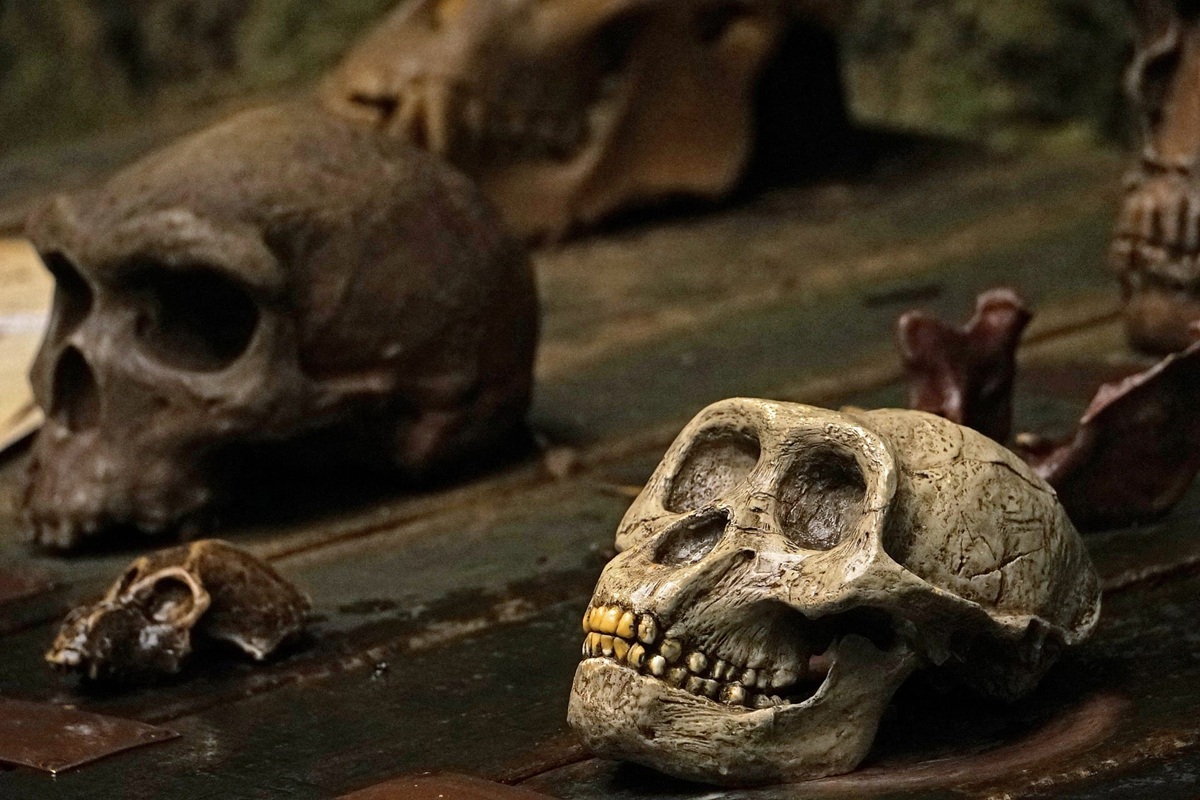
To talk about human evolution is to talk about a gigantic jigsaw puzzle, a large part of which we have completed, but whose last pieces still elude us. Many people continue to try to fit these pieces together, and each new fossil studied brings us one step closer to our goal or to rethinking everything. One of these questions was how quickly the hominid brain evolved in relation to that of the great apes, and the conclusion of a new study was devastating.
The hypothesis. Researchers at University College London, led by Spanish scientist Aída Gómez-Robles, started from a well-known premise: modern humans have brains that are about three times larger than those of our closest ape relatives. And not only a different size, but also a remarkably distinct skull structure. While most great apes have forward-projecting faces and small brains, humans have a flatter face with a larger, rounded head. The exception among apes would be gibbons and their rounded heads, but with much smaller brains. The hypothesis they worked with was that these craniofacial adaptations evolved at an accelerated rate in humans thanks to the advantages of having a large brain, but also that social factors would have influenced this accelerated transformation.
The study. The team examined virtual models of skulls from various species of modern primates. They analysed skulls from seven species of “great apes”, including humans, two species of gorillas, two species of orangutans, chimpanzees and bonobos, as well as nine species of hylobatids or “lesser apes”, such as the gibbons mentioned above. To do this, using a technique that allows reference points in anatomical structures to be mapped, the researchers divided each skull into four sections. They analysed the markers on the upper face, lower face, front and back of the head and compared them across all the skulls analysed. They used hylobatids as a control group, since the species separated from hominids about 20 million years ago, and they noticed something: while gibbons are very similar to each other, hominids are very different from each other. And among them, humans are the most evolved. At an impressive speed, too.

Face + neurocranium. The conclusion is that the human brain evolved twice as fast as that of other hominids. Studies had already been done on what additional factors drove accelerated changes in the brain and skull, but this study is the first to quantify the speed at which different species evolved. And, in addition to speed, what they found is that the human face changed almost as quickly as the neurocranium. Brain expansion and facial flattening are related, but in other species there is not such a clear relationship between the evolution of the neurocranium and the face. Therefore, the team concluded that there was something external at play: selective pressure caused by the fact that we began to live in society.
‘The face is the interface through which we interact with other people, so one possible explanation is that the selective pressure that caused its accelerated evolution is related to how we interact with each other in a social group,’ explains Gómez-Robles.
Implications. This did not happen exclusively with humans. In the case of gorillas, the UCL team concluded that they had the second fastest rate of cranial evolution, probably also driven by social selection, implying that a larger cranial crest is a symbol of higher social status. However, as we said at the beginning, although the UCL study has demonstrated the evolution of human brain growth in relation to that of other similar species, there are still pieces missing to complete the big puzzle. Future studies may examine other aspects to better understand what biological or social factors drove accelerated cranial development in humans.