
The bridge uses 60% less material without losing structural strength. Its porous shape increases the contact surface, improving carbon capture by an additional 30%.
This 3D-printed bridge that absorbs carbon is inspired by bones
The 10-metre-long prototype of the Diamanti bridge is currently on display in Venice.
Strong, versatile, cheap and ubiquitous, concrete is the most widely used manufactured material in the world. But it is also one of the most polluting: it generates around 8% of global greenhouse gas emissions. For decades, the concrete and cement industry has tried to reduce its environmental impact through cleaner mixes or more efficient designs. The Diamanti project, developed by a research team at the University of Pennsylvania, combines both strategies in a single bold and functional proposal.
Inspired by nature, manufactured with precision
Diamanti does not just improve the concrete mix. It also revolutionises its geometry. Inspired by porous bone structures, it uses a robotic 3D printer to generate complex patterns with an optimised concrete mix. These patterns, known as triply periodic minimal structures (TPMS), replicate the way bones distribute load without needing to be completely solid.
The result: a structure that is 60% lighter, but without losing strength. At the same time, the exposed surface of the concrete increases, which improves its ability to absorb carbon dioxide by up to an additional 30%. Add to that a mixture that already absorbs 142% more CO₂ than conventional concrete, and the environmental impact is dramatically reduced.
Materials that breathe
One of the keys to this innovation is the use of diatomaceous earth (DE). This is a siliceous, porous material formed from the fossilised remains of microalgae, which replaces part of the cement in the mixture. This substitution not only reduces the carbon footprint of the manufacturing process, but also creates micropores that allow for greater capture of atmospheric CO₂ throughout the material’s useful life. In 2023, global production of diatomaceous earth was 2.6 million tonnes, which raises questions about the scalability of the model. Although it is still too early for mass adoption, it may be a viable solution in regions where this resource is available locally.
The cement industry faces its biggest challenge
Cement is responsible for around 90% of emissions associated with concrete. This is due both to the calcination process of calcium carbonate (which releases CO₂), and to the extreme energy consumption involved in reaching temperatures of up to 2,000 °C in kilns. Despite the efforts of the sector — which achieved a 25% reduction in emissions per tonne between 1990 and 2023 — increased demand has offset these advances. According to the International Energy Agency (IEA), total emissions from the sector remain higher than in 2015. Therefore, innovation cannot be limited to changes in the formula. It is necessary to rethink the way it is designed and built. This is where projects such as Diamanti make a difference: its multidimensional approach simultaneously addresses the amount of material, the mix, the shape and the construction process.
Modular and efficient construction
The bridge is built in modules, printed in blocks with a robotic arm and assembled on site using tension cables. This strategy not only allows for faster manufacturing, but also reduces the use of steel by 80% — another material with a high environmental impact. According to Masoud Akbarzadeh, project leader, this technique allows for a 25-30% reduction in construction costs, while reducing energy consumption and associated emissions by 25% compared to traditional methods. After successfully testing a 5-metre prototype, the team built a 10-metre version that passed load tests. This structure is currently on display at the Venice Architecture Biennale 2025.
Next destination: France
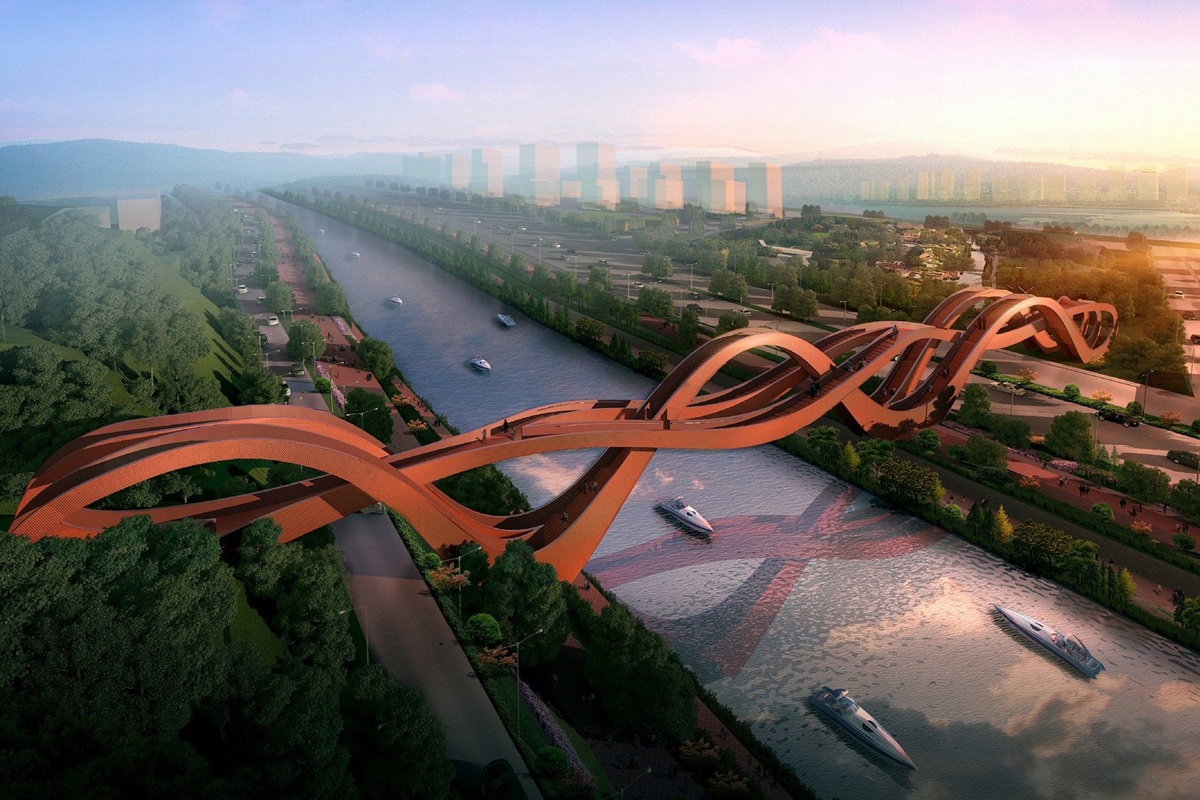
Although the initial goal was to build the first functional bridge in Venice, a change in local regulations forced the team to look for another location. Finally, in September, the project received the green light to build its first full-scale bridge in France, although the exact location has not yet been confirmed. Digital visualisations have been developed that show how this bridge could be integrated into the urban environment, including proposals to install it on the River Seine in Paris. If realised, it would become a tangible symbol of how architecture can dialogue with the environment without compromising functionality.
Beyond bridges
The University of Pennsylvania team is already working on other architectural applications, such as prefabricated flooring systems, which would also benefit from these porous structures and absorbent materials. This is not a magic solution. Rather, it is a new way of thinking about concrete, with the potential to transform the way cities are built, especially in a context of rapid urbanisation and climate emergency.
Potential
Diamanti’s approach offers clear clues on how to move towards more conscious construction:
- Biomimetic design: learning from nature is not a metaphor, it is a functional strategy. TPMS structures demonstrate that it is possible to reduce material without sacrificing safety.
- 3D as a tool for efficiency: 3D printing allows for the manufacture of customised parts with minimal waste of resources and eliminates the need for complex formwork.
- Less cement, more intelligence: replacing part of the cement with biomaterials such as diatomaceous earth opens the door to more “breathable” concretes, with a second life as carbon sinks.
- Scalable modularity: building with connectable blocks facilitates transport, assembly and maintenance, making it ideal for dense urban areas or regions with limited infrastructure.
- Replicable applications: the same principles can be adapted to social housing, public spaces and even low-cost rural infrastructure.
Sustainability in construction will not be achieved with a single innovation, but with the sum of intelligent decisions and conscious materials. Diamanti is a good example of how science, technology and design can work together to build not only physical bridges, but paths to a more habitable planet.